

- Home
- Case Studies
- Telecom RBT Case Study
Telecom RBT Case Study
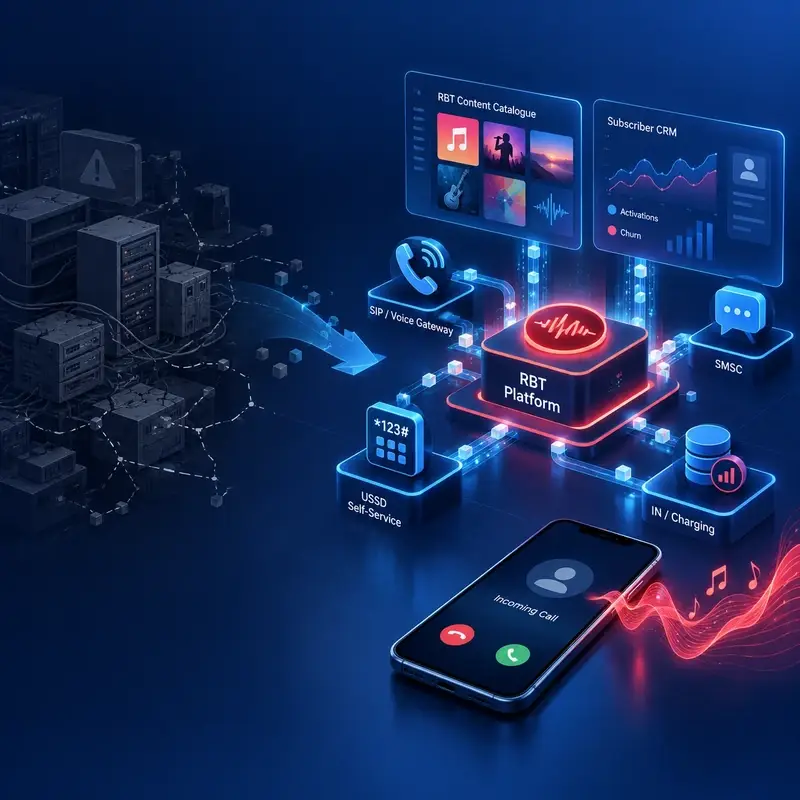
We replaced a major East African operator’s failing RBT system with a platform integrated across SIP, SMSC, USSD and IN charging. It includes a custom VAS subscriber CRM and was cut over with zero disruption to active subscribers.
The Challenge
A major telecom operator in East Africa was running a Ring-Back Tone service on a platform that had
become a liability. Subscriber activation flows were unreliable. Integration with the operator’s Intelligent
Network charging system was fragile. Content management required manual interventions. Subscribers
would activate a tone and find it not applied; deactivation requests would not process correctly. The
platform had reached the end of its useful life, but replacing core telecom infrastructure is not a
standard software project.
The stakes were real. RBT is a revenue-generating VAS product for the operator. A migration done
poorly means subscriber-facing failures, revenue loss, and operational disruption at scale. The operator
needed a partner who understood how to build and integrate at the protocol level of their core network, not a vendor who would attempt to replicate the surface behaviour without understanding the underlying
infrastructure.
What We Built
Core Network Integration
- SIP gateway integration- RBT trigger handling fully integrated with the operator's core voice network via SIP signalling
- SMSC integration via SMPP v3.4- all subscriber activation, deactivation, and status notifications routed through the operator's messaging infrastructure
- IVR and USSD self-service menus- subscribers can activate, deactivate, browse content, and manage their RBT subscription directly
- REST API integration- real-time charging interface connected to the operator's Intelligent Network for accurate, event-triggered VAS billing
Content Management System
- Audio content ingestion and management- upload, categorise, tag, and schedule tones for promotion through the operator's content team
- Content catalogue- searchable and browsable by genre, artist, and popularity, surfaced through the USSD menu
- Promotional scheduling- operator can run featured-tone campaigns and seasonal promotions without developer involvement
Custom VAS Subscriber CRM
- End-to-end subscriber lifecycle management- activations, renewals, deactivations, grace periods, and reactivation flows all managed through a single CRM purpose-built for telecom VAS
- Campaign management- targeted VAS promotions by subscriber segment, usage behaviour, and tier
- Reporting- daily and monthly reporting on subscriber counts, churn, revenue, and content popularity
Migration
- Existing subscribers migrated to the new platform with zero disruption to active subscriptions
- Parallel running period- both platforms operated simultaneously during cutover to ensure no subscriber-facing failures before full switchover
Outcome
- Legacy RBT platform successfully replaced- new platform live in production. Subscriber activation and deactivation flows reliable. Core network integration stable across SIP, SMSC, and IN interfaces. Content team manages the catalogue independently. Operator's customer care team operates from the CRM without developer involvement.
Technology Stack
Telecom VAS platforms live or die at the protocol layer. We built this platform to integrate directly with the operator’s core network, covering voice signalling, messaging, self-service and real-time charging. The application stack around it keeps subscriber operations, content and reporting running without developer involvement.
SIP / VoIP
- Asterisk - SIP gateway for RBT trigger handling
SMSC
- SMPP v3.4 - subscriber notification and activation messaging
USSD
- USSD gateway
- MAP protocol - subscriber self-service menus
IN/ Charging
- Intelligent Network - real-time charging integration
- Integration with HLR via IN proprietory protocols
CRM
- Custom-built - subscriber lifecycle
- Support
- Campaign management
Frontend
- Angular - CRM
- Content management
- Analytics portals
Backend
- Node.js (NestJS)
- Java Spring Boot
Database
- PostgreSQL
- Redis
Need a Telecom Partner Who Understands the Protocol Level?
Whether you are building a new VAS platform or replacing one that is not performing- this is
a conversation worth having.